Traditional computer
Your laptop, smartphone, and desktop use bits. Each bit is either 0 or 1.
For example, your computer processes information using billions of electronic operations.
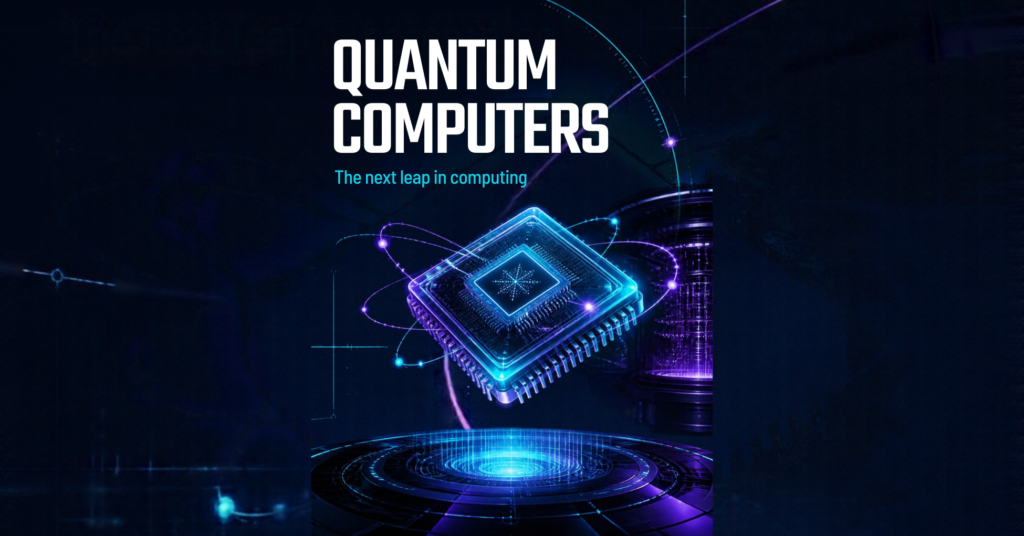
Quantum computer
It uses quantum bits, called qubits. Qubits can use quantum effects such as superposition and entanglement to process information in ways ordinary bits cannot.
This can offer major advantages for certain specialized problems.
Quantum Computers: A New Way to Compute
Every computer you have ever used, from the phone in your pocket to the largest data center, works on the same basic idea. Information is stored as bits, and each bit is either a 0 or a 1. Quantum computers break from that idea, and that is why researchers, governments, and companies are paying such close attention to them.
What Makes Them Different
A quantum computer uses qubits instead of bits. Thanks to a property called superposition, a qubit can exist in a blend of 0 and 1 until it is measured. A second property, entanglement, links qubits so that the state of one is tied to the state of another, even when they are physically separated.
Together, these properties let a quantum computer explore many possibilities at once. It does not simply try every answer in parallel, which is a common misconception. Instead, quantum algorithms are carefully designed so that wrong answers cancel each other out and right answers are reinforced. Designing those algorithms is difficult, which is why quantum computers aren’t simply faster versions of ordinary ones.
The simplest way to remember
- Bit = the foundation of ordinary computing.
- Qubit = the foundation of quantum computing.
- Bits power the devices we use every day.
- Qubits may help tackle certain specialized scientific and mathematical problems.
What They Could Be Good At
Quantum machines are not expected to replace your laptop. They are specialists, and the most promising uses include:
- Chemistry and materials science. Molecules obey quantum rules, so a quantum computer can simulate them far more naturally than a classical one. This could speed up the search for new medicines, better batteries, and cleaner fertilizers.
- Optimization. Logistics, scheduling, and financial modeling involve choosing the best option from enormous numbers of combinations.
- Cryptography. Certain quantum algorithms could eventually break the encryption that protects much of today’s internet traffic.
- Scientific research. Physics, climate modeling, and fundamental science may benefit from simulations that are currently out of reach.
The Security Question
The cryptography point deserves extra attention. Much of online security depends on math problems that are practically impossible for classical computers to solve but could be manageable for a large, reliable quantum computer. That day has not arrived, but data stolen today could be stored and decrypted later. In response, standards bodies and security teams have been developing post-quantum cryptography, new encryption methods designed to resist quantum attacks. Organizations that handle sensitive long-term data are already planning their transition.
Why It Is So Hard to Build
Qubits are fragile. Heat, vibration, stray electromagnetic signals, and even the act of measuring them can disturb their state, a problem known as decoherence. Many designs require extreme cooling, with some systems operating at temperatures colder than outer space.
Because of this fragility, quantum computers make errors constantly. The central engineering challenge is error correction: combining many imperfect physical qubits into fewer, more reliable logical qubits. Doing this at scale will likely require machines with far more qubits than exist today. Researchers are pursuing several approaches, including superconducting circuits, trapped ions, neutral atoms, photons, and spin-based systems, and it is still unclear which will win out.
Where Things Stand
Quantum computing today is often described as being in an early, experimental phase. Current devices can run interesting experiments and have shown advantages on narrowly defined tasks, but they are not yet delivering broad, practical benefits over classical supercomputers. Progress in qubit quality, error correction, and software is steady, though timelines for truly useful, large-scale machines remain uncertain, and predictions vary widely among experts.
Can quantum replace traditional computers?
Quantum computing is not magic, and it is not a replacement for the computers we already rely on. It is a fundamentally different tool, suited to problems that classical machines struggle with. The road from laboratory prototype to everyday impact will be long and full of surprises, but the potential is large enough that the effort is well justified. Keep an eye on this field, because the next few decades may reshape what we think computers can do.